Billiard Hero™️
- 4.5
- Rating
- 1.00M
- Installs
- Free
- Price

 Analysis by App-foxy
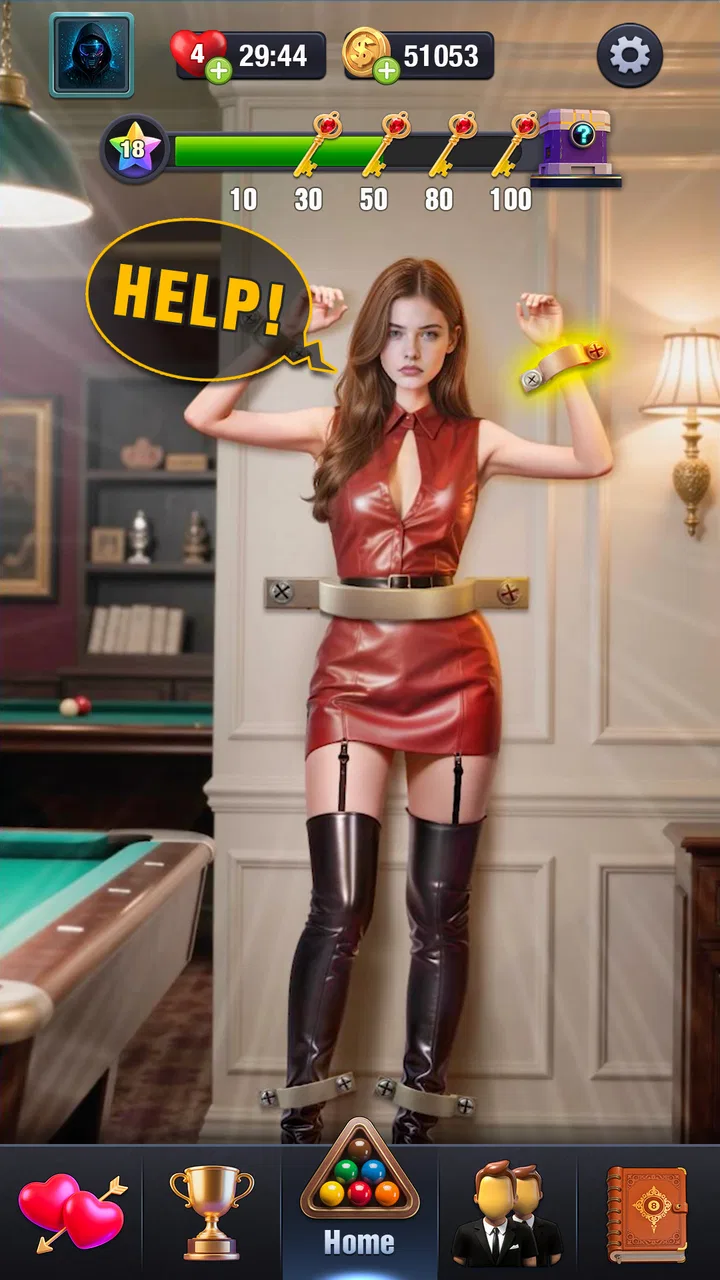
I spent my first sessions with Billiard Hero™️: Rescue Shot expecting a simple pool game, and that is exactly where its appeal begins. It is a free sports game from homeboy91 built around clearing pool stages with as few shots as possible while trying to rescue a waiting character. That framing gives each table a small objective beyond merely sinking balls, so even a short break can feel like a complete challenge.
The basic idea is easy to understand within seconds, but the better question is whether this kind of compact billiards puzzle deserves a permanent place on a phone. My answer is qualified: it is pleasant when I want a quick aiming exercise, especially during the first week, but its lasting value depends heavily on how much repetition I can tolerate. It is not trying to replace a full pool simulation, and it works best when treated as a focused casual game rather than an all-purpose sports title.
Why the first sessions feel immediately rewarding
The rescue premise gives the opening stages a useful sense of direction. Instead of entering a table with no reason beyond practice, I have a clear mental target: plan the shot, remove the obstacle, and move closer to the rescue. The store summary describes the experience as clearing pool stages in few shots, and that emphasis matters. I naturally begin counting opportunities, looking for angles, and resisting the temptation to fire immediately.
You May Also Like

 Google Keep - Notes and lists
Google Keep’s Quiet Growth Shows the Appeal of Simpler Notes
As mobile work gets busier, Google Keep keeps winning a simple contest: capture a thought quickly, find it later, and get on with the day.

 Blood Strike: 2.5 Anniversary
Blood Strike’s Loadouts Turn Every Drop Into a Tactical Gamble
A close look at Blood Strike’s custom loadouts: how fast access to signature weapons reshapes its battle royale rhythm, rewards preparation, and narrows the gap between fights.

 Pandora - Music & Podcasts
Pandora’s Music Is Easy to Start, but Harder to Recover
Pandora’s strength is its low-effort path from a seed to a station. Its weak spot is how much confidence it asks you to place in connection, setup, and quiet recovery.

 8 Ball Pool
 Is Built on Rivalries, Rematches, and Routine
A close look at the rivalries, rematches, shared routines, and unanswered safety questions that turn a quick pool match into a persistent mobile community.

 Samsung Music
’s Quiet Strength Is Playing What You Already Own
Its reach comes less from spectacle than from dependable access to a personal library. That simplicity is both the app’s strongest retention engine and its ceiling.

 AccuWeather: Weather Radar
AccuWeather Review: A Quick, Clear Forecast for Everyday Decisions
For everyday plans, the best forecast is the one you can understand quickly. AccuWeather makes rain timing, radar, and local conditions easy to act on, with a few trade-offs.
More From Our News Desk



That makes the game accessible to people who do not usually play billiards games. You do not need to learn a large rule set before enjoying it. A person who understands the basic idea of directing a cue ball can start experimenting right away. The Teen content rating also places it in a space that is more suitable for older children and adults than for very young players, so I would keep that age guidance in mind when deciding whether it is appropriate for a family device.
In my experience, the strongest early pleasure comes from correcting a bad first instinct. I may see an obvious ball and aim directly at it, only to realize that the cue ball will finish in an awkward position. Taking a moment to consider the next contact makes the stage feel more like a compact logic problem. That second-look habit is more satisfying than simply tapping through uncomplicated tables.
It works especially well in short everyday breaks
A realistic use case is a ten-minute wait before an appointment. I can play a few stages without needing to remember a complicated story or rebuild a long strategy. The rescue objective gives each attempt a beginning and an end, while the billiards format keeps the interaction familiar. This is the sort of game I would open when I want something more active than scrolling but less demanding than a long competitive match.
It also suits players who enjoy improving a solution rather than collecting a large amount of content. A stage can be approached as a quick attempt first and a cleaner attempt later. That creates a small personal challenge: not merely finishing, but finishing with better control. The difference is important because it gives the game some value after the initial novelty has faded, even if the overall structure remains straightforward.
At the same time, I would not describe the first-week experience as a complete pool simulation. Players looking for realistic rules, detailed cue control, online competition, or the atmosphere of a full billiard hall may find the rescue-stage format too narrow. Its strength is concentration in small doses, not breadth.
What to watch during the first week
My best practical advice is to avoid treating every shot as a race. The few-shot goal encourages quick decisions, but rushing often creates a worse position for the next ball. I found it more useful to identify the intended order before aiming. Even when the stage looks simple, the first successful contact may determine whether the rest of the table remains manageable.
Another useful habit is to separate aiming mistakes from planning mistakes. If the target line was correct but the result was poor, I need to adjust execution. If the shot succeeded but left no sensible follow-up, the problem was the order of play. That distinction makes retries more informative and prevents the game from becoming random trial and error.
Because the game is free, it is also easy to test without making a commitment. The current release is version 1.0.27, and it runs on Android devices using version 6.0 or later. That makes it relevant to people who keep an older phone for casual gaming, although actual comfort will still depend on the device’s screen and touch response. A larger display can make careful aiming feel less cramped than a small handset.
Whether the stages retain value from month to month
The month-to-month question is harder than the first-week question. A rescue-based pool puzzle has a clear learning curve: I become better at reading angles, protecting the cue ball’s position, and recognizing which target should come first. That improvement is real, but it can also reduce the surprise. Once I understand the common shape of a stage, the emotional pull of the rescue theme may become less important than the quality of the shot puzzle itself.
This is where the game’s recurring value depends on my personal habits. If I enjoy replaying a familiar type of challenge to improve my efficiency, I can return regularly. If I need constant new mechanics, changing environments, or a strong progression system to stay interested, the compact format may lose its grip. I would not install it expecting an endless sports career; I would install it as a repeatable pocket puzzle with a billiards skin and a light objective.
The public response gives a useful but modest signal. It has an average rating of 3.6 from around 500 ratings, alongside more than 100 thousand installs. I read that as evidence of genuine interest without treating it as a guarantee. The audience is large enough to show that the concept connects with many casual players, while the middle-of-the-road rating suggests that the experience will not satisfy everyone equally.
Who is most likely to keep returning
I can see lasting use for three kinds of players. The first is someone who likes precision games but does not want a long session. The second is a casual pool fan who enjoys planning shots without needing a full set of real-world rules. The third is a player who turns small improvements into a personal routine, such as replaying a stage until the solution feels clean rather than merely successful.
For those players, the game can become a short daily exercise in visual planning. I would use it between larger games, during travel, or when I have only a few minutes and want a clear stopping point. The fact that it is free lowers the barrier to keeping it installed, especially if I am comfortable with its style and do not need a deep progression system.
It is less suitable for someone who wants social competition or a realistic match against another person. A conventional pool simulator would be a better choice for learning formal rules, practicing a broader range of shots, or recreating the feel of a real table. A physics-heavy billiards game may also offer more satisfaction to players who care about spin, table behavior, and detailed control. Billiard Hero’s advantage is the stage objective, not simulation depth.
How I would build a repeatable routine
I would avoid playing until every stage starts to feel like work. A short session of several attempts is enough to preserve the game’s puzzle quality. When I notice that I am making shots without thinking, I would stop and return later. This is a small but important trade-off: the game benefits from being consumed in portions, and pushing through fatigue can make its simple structure feel thinner than it really is.
I would also replay selectively rather than automatically chasing perfection. A stage that teaches a useful angle or exposes a planning error is worth another visit. A stage that only demands repeated correction of a touch mistake may not justify much time. This approach helps preserve the satisfying part of the experience while limiting the frustration that can come from repeating an outcome that feels outside my control.
The rescue framing can help with motivation, but I would not rely on it alone for long-term engagement. Once I know the premise, the lasting reason to return has to come from the quality of the table challenge. That is why the game feels strongest for players who enjoy the act of solving, not just the story wrapper around the solve.
Maintenance, friction, and the cost of keeping it installed
Keeping a casual game on a phone is not only about whether it is fun. I also consider how often I want to return, whether it fits my available attention, and whether it creates more irritation than relaxation. Since Billiard Hero is free, the financial commitment is minimal. The more meaningful cost is storage and attention: an app that sits unused is not harmful by itself, but it still competes with other games for space and with more rewarding activities for time.
Compatibility is reasonably broad because the listed minimum is Android 6.0. That is helpful for people using an older device, but it should not be confused with a promise of identical comfort everywhere. Precision games expose weak touch responsiveness more clearly than many other genres. If aiming feels inconsistent on a particular phone, the experience can become frustrating even when the underlying stage design is sound.
I would also approach updates with practical expectations. The current version is 1.0.27, so I would keep the app updated through the normal store process rather than assuming an older installation will always behave the same way. Updates matter more for a touch-based game than they might for a static reading app because small changes in responsiveness or presentation can affect how shots feel. I would check that it remains comfortable on my device after updating, especially if I rely on it for quick sessions.
Where the experience can become tiring
The first source of fatigue is repetition. Pool puzzles naturally reuse the same vocabulary of angles, obstacles, and shot order. That is part of their appeal, but it also means the game must keep presenting situations that make me reconsider my first plan. When several stages feel solved before I touch the screen, the rescue objective no longer adds much energy.
The second source is precision frustration. A missed shot can be my fault, which is satisfying when I learn from it. It is less satisfying when the result feels like a tiny aiming discrepancy rather than a meaningful strategic error. For a game built around clearing stages in few shots, the line between challenging and fiddly is narrow. I would judge it by whether retries teach me something, not simply by whether they make me repeat the same action.
The third source is a mismatch between expectation and genre. The word “billiard” may lead some players to expect a complete table simulator, while this is better understood as a stage-based rescue puzzle using pool mechanics. Knowing that before installing it prevents disappointment. I would recommend it to a friend who wants compact shot planning, but not to a friend asking for a serious digital replacement for playing pool.
There is also a motivational limit to the narrative premise. Rescuing a character is a clear reason to begin, yet a simple objective can lose force once it becomes familiar. That does not make the concept unsuccessful; it means the game’s long-term test is mechanical. If the aiming and stage decisions remain enjoyable, the theme can stay pleasant in the background. If the tables become routine, the theme alone is unlikely to keep me playing.
My long-term verdict on Billiard Hero
After the novelty fades, I think Billiard Hero™️: Rescue Shot earns a place on a phone for a specific audience rather than for everyone. I would keep it installed if I wanted a free, quick sports puzzle that rewards thinking about shot order and careful execution. Its strongest quality is the way it turns a familiar pool action into a small rescue task, giving short sessions a clearer purpose than an unstructured practice table.
I would skip it if my priority were realistic billiards, deep competition, or a large variety of systems. A traditional pool game would better serve someone learning the sport’s rules, while a more advanced simulator would be preferable for players who want detailed physics and technical control. This game is more approachable and less demanding, but that simplicity is also the reason its staying power may vary.
The rating of Teen is worth respecting, and the free price makes experimentation easy. The developer, homeboy91, has positioned the game as a focused casual experience rather than a premium-length sports production. That positioning works when I use it in the right way: a few thoughtful stages, a short attempt to improve a solution, then a break before the repetition turns stale.
My final recommendation is to try it with modest expectations and a clear use case. Install it for waiting rooms, brief commutes, or moments when you want a puzzle that feels more tactile than a typical logic game. Give it a fair test by planning shots instead of rushing through them. If that process remains satisfying after the initial rescue novelty disappears, it can become a useful little habit. If you are looking for a complete pool experience, you will probably outgrow it quickly.
The lasting value is in the shot decisions, not the rescue slogan. That is both the game’s most honest strength and its main limitation. Players who enjoy compact precision challenges may find enough recurring pleasure to keep returning, while everyone else should see it as a lightweight free experiment rather than a permanent centerpiece of a mobile sports collection.
FAQs for Billiard Hero™️
01What is Billiard Hero™️: Rescue Shot?
Billiard Hero™️: Rescue Shot is a mobile game that combines traditional billiard mechanics with exciting puzzle-solving challenges. Players navigate a series of levels where they must strategically use their cue to rescue trapped characters by hitting targets. The game is available for both Android and iOS devices, offering engaging gameplay for billiard enthusiasts and puzzle lovers alike.
02How do you play Billiard Hero™️: Rescue Shot?
The game involves using a virtual cue to aim and shoot balls towards specific targets on the table. The objective is to solve each puzzle by rescuing characters trapped in tricky setups. Players must carefully calculate angles and power to achieve the best shot. As levels progress, the puzzles become increasingly complex, requiring strategic thinking and precision.
03Are there in-app purchases in Billiard Hero™️: Rescue Shot?
Yes, Billiard Hero™️: Rescue Shot offers in-app purchases. While the game is free to download, players can buy additional items such as power-ups or extra lives. These purchases can enhance gameplay, although they are not necessary to complete the game. Players can choose whether or not to invest in these extras based on their preference.
04Is Billiard Hero™️: Rescue Shot suitable for children?
Billiard Hero™️: Rescue Shot is generally suitable for children, as it features colorful graphics and non-violent gameplay. However, parents should be aware of the in-app purchases and ensure that children understand the costs associated. The game can help improve strategic thinking and problem-solving skills, making it a potentially educational experience for young players.
05Does Billiard Hero™️: Rescue Shot require an internet connection?
Billiard Hero™️: Rescue Shot can be played offline, which is great for users who do not have consistent internet access. However, certain features like leaderboards or daily challenges may require an internet connection to function. Playing offline will not hinder the main gameplay experience, allowing players to enjoy the game wherever they are.
Pros
- Engaging physics for realistic gameplay.
- Variety of levels keeps it interesting.
- Easy controls for smooth play.
- Visually appealing graphics.
- Regular updates with new challenges.
Cons
- In-app purchases can get expensive.
- Ads can interrupt gameplay.
- Requires internet for some features.
- Limited customization options.
- Occasional bugs in older devices.

Billiard Hero™️
Gallery